Price & delivery time
One fixed price, with no vehicle types or validity periods to choose from. The environmental sticker applies to every vehicle, once, for life.
Environmental sticker Spain
- Delivery time: 10–21 business days (we process the application through the same French partner as the Crit'Air sticker, hence the same delivery time)
- The sticker is sent by post, from France
- Applying once is enough: you never need to renew or reapply, not even next year
Why an environmental sticker in Spain?
More and more Spanish cities are expanding their low-emission zones (Zonas de Bajas Emisiones). A recognisable environmental sticker on the windscreen makes inspection straightforward and avoids unnecessary discussion or a fine, even if your car actually meets the requirements: without a sticker, that simply isn't visible to the inspector.
How long does the sticker stay valid?
The sticker is linked to your vehicle and stays valid for life, for as long as you own the same car. So you never need to renew it annually. If you sell the car, the new owner applies for their own new sticker.
Which DGT category will your vehicle get?
The Spanish traffic authority, the DGT, has 4 environmental labels: 0 emisiones, ECO, C, and B. Spain's ZBEs (Zonas de Bajas Emisiones) are increasingly excluding vehicles without a label altogether, and the strictest zones also restrict label B. Which label your car receives is determined automatically by the DGT based on fuel type, Euro standard, and registration date; we apply for the sticker on your behalf regardless of the outcome.
How to recognise a low-emission zone
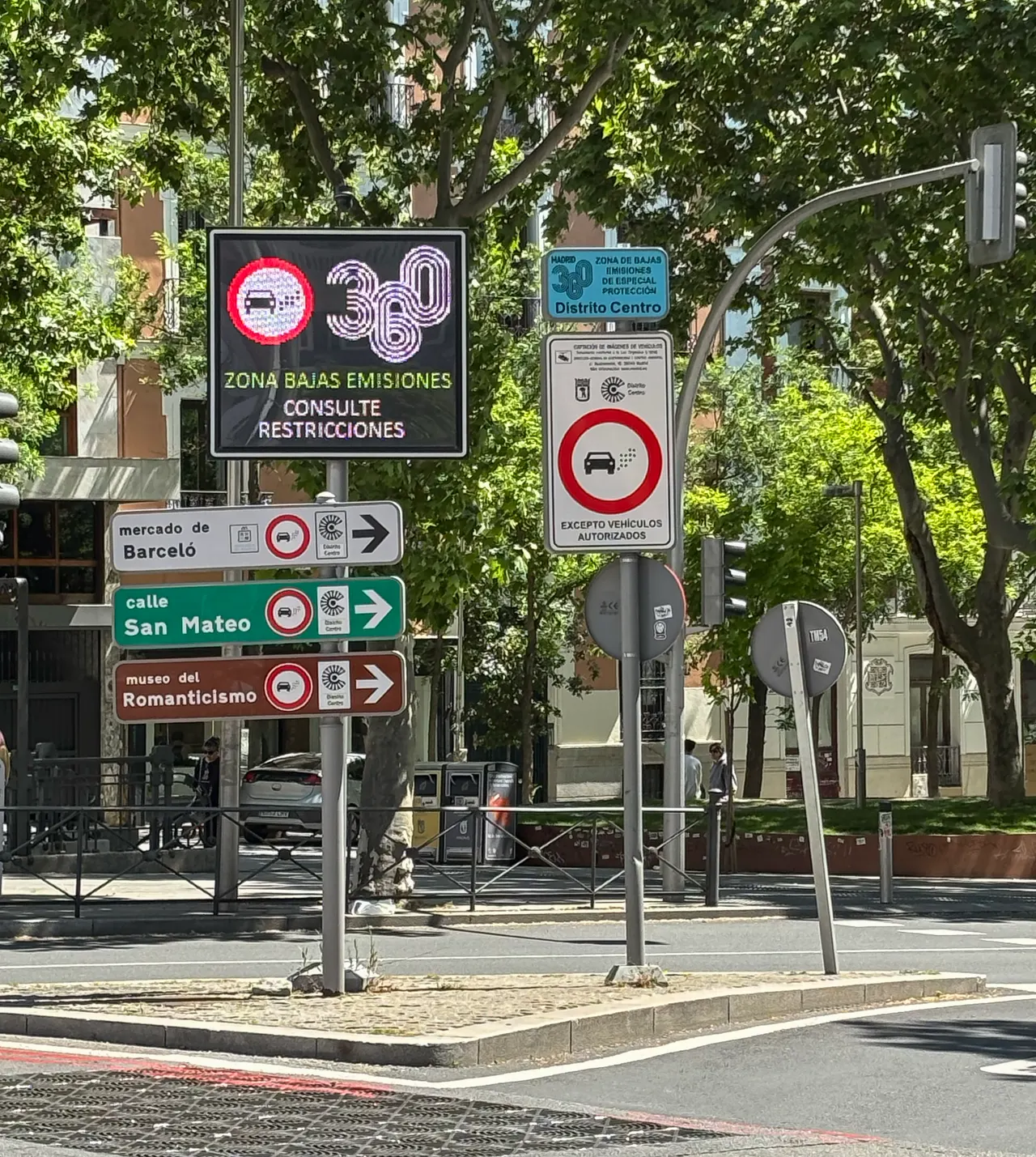
A Zona de Bajas Emisiones begins at a sign reading "Zona de Bajas Emisiones" or "ZBE", often supplemented with the permitted environmental labels. Cities with an active ZBE include Madrid (Madrid Central/ZBE Distrito Centro), Barcelona, Seville, Valencia, Córdoba, A Coruña, Pontevedra, Badalona, Rivas-Vaciamadrid and Sant Cugat del Vallès. Since 1 January 2026, every Spanish municipality with more than 50,000 residents has been legally required to have set up a ZBE, so this number keeps growing. Málaga has been using camera enforcement for its own ZBE since 30 November 2025.
Enforcement is increasingly handled in more and more cities through automatic number plate recognition (cameras) at the access roads: Madrid has 257 of these checkpoints, Barcelona 147. Without a valid environmental sticker on the windscreen, an inspector or camera system can't establish your label, even if your car actually meets the requirements.
Fines and enforcement
Drive into a Spanish ZBE without a valid environmental label, and you risk a fine of up to € 200, reduced to € 100 with prompt payment. This applies equally to Spanish and foreign licence plates: without the sticker on the windscreen, enforcement simply can't recognise your vehicle as exempt.